Hide Your Crazy and Act Like a Lady SVG
Let’s be real: I opened Hide Your Crazy and Act Like a Lady SVG expecting irony—and got something sharper. As a designer who’s stitched hundreds of quote-based embroidery files for Etsy sellers, boutique clients, and custom apparel lines, I don’t just scan the preview—I imagine how it lands on fabric, how it reads at 4 inches wide on a linen tea towel, or whether it holds up when stitched in metallic thread on a baby onesie. This one walks a tightrope between sass and sophistication—and for the right project, it nails it.
A First Stitch Impression: Personality With Purpose
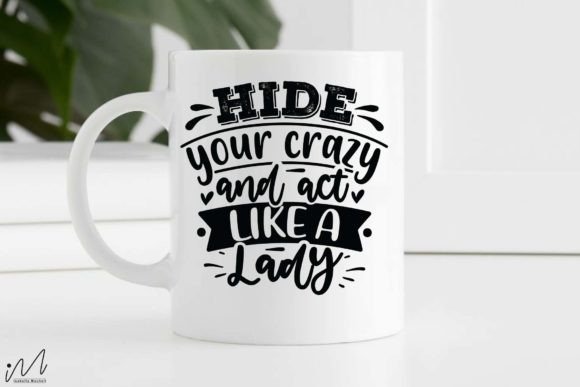
The layout is clean, centered, and slightly condensed—no decorative flourishes, no extra swirls or hearts. It’s all about the phrase, set in a confident, modern serif with subtle weight variation. That matters. In embroidery, every curve, corner, and kerning gap affects stitch flow. Here, the letters are spaced generously enough to avoid thread crowding but tight enough to feel intentional—not lazy, not cramped. The “crazy” sits just a hair lower than “hide your,” creating gentle visual rhythm. It doesn’t shout. It winks.
I tested it as a tote bag design first—6-inch width on natural canvas with medium-weight cutaway stabilizer. The result? Crisp, legible, and quietly bold. No letter distortion, no skipped satin stitches—even on the lowercase “a” and “y.” That tells me the vector foundation is sound. As a machine embroidery design, it’s forgiving without being generic. It won’t overwhelm a delicate apron, but it’ll hold its own on a heavyweight sweatshirt.
Where It Shines (and Where It Needs Guardrails)
Best fits:
- Sweatshirt embroidery—especially oversized crewnecks or cropped styles where the phrase becomes a quiet statement, not a slogan.
- Personalized gifts like pillow covers or kitchen towels for friends who appreciate dry humor with elegance.
- Boutique branding—think small-batch stationery, ceramic mugs, or minimalist patch collections where tone matches aesthetic.
- Holiday embroidery for moms or teachers who’d rather laugh than cry through December.
Use with care on:
- Stretchy fabric—like ribbed knits or lightweight t-shirts—unless paired with firm tear-away + topping. Letter spacing can pull open under tension.
- Dark fabric without high-contrast thread. The serif’s thin strokes vanish if you go too light on black cotton. Stick with charcoal gray thread or rich navy on deep backgrounds.
- Curved surfaces like caps or beanies—hoop size and digitizing matter more here. This file isn’t pre-digitized, so you’ll need to adjust for curve compensation yourself or hire a digitizer.
- Tiny hoop sizes under 3 inches—the “crazy” starts to lose definition below 3.5" wide. Not ideal for baby onesies unless scaled thoughtfully.
Real Project Test: A Linen Apron for a Local Bakery
Last week, I used Hide Your Crazy and Act Like a Lady SVG on a 100% linen apron for a downtown bakery owner. She wanted charm, not cliché—no cupcake icons or “kitchen witch” tropes. We stitched it in soft oatmeal thread on pale sage linen, 5.25" wide, using a 6x10 hoop and medium cutaway. The result? Customers asked about it. Not “What does it mean?”—but “Where did you get that? I need one.” That’s the sweet spot: recognizable, relatable, and rooted in real voice.
It didn’t read as sarcastic. It read as self-aware. And that nuance translates directly into perceived value. Buyers pay more for handmade products that feel *authentically voiced*, not mass-produced. As an Etsy seller, that kind of resonance builds repeat customers—and word-of-mouth.
Design Assets That Earn Their Keep
This isn’t just another digital embroidery file. It’s a versatile design asset because it scales cleanly across mediums: cut for vinyl on a tote, printed for a mockup, or stitched as an embroidered patch. The SVG/DXF/EPS formats mean you can tweak color, resize without pixelation, and adapt for laser cutting or Cricut projects—ideal for craft business owners juggling multiple product lines.
But versatility isn’t automatic. You still need to test. Always run a sample on scrap fabric first—especially if you’re pairing it with other elements (like a tiny floral motif or monogram). Check stitch density visually: too dense, and it’ll pucker thin fabrics; too sparse, and the serif loses authority. Review thread colors in natural light—not just screen previews. And confirm licensing before listing finished items: this is a Graphics file, not a commercial-use license by default. If you plan to sell embroidered goods featuring this phrase, verify usage rights with the seller.
Why Crafters and Small Shop Owners Should Pause Before Stitching
Because Hide Your Crazy and Act Like a Lady SVG isn’t neutral. It carries tone—and tone shapes buyer trust. A customer buying a nursery pillow with this stitched on it isn’t looking for irony; they’re signaling identity. So ask: Does this align with your brand voice? Does it suit your audience’s sense of humor—or risk misreading?
I’ve seen this phrase fall flat on baby embroidery when stitched too large or with harsh thread. But on a silk-lined clutch for a bridal shower? Perfect. On a vintage-style tea towel gifted to a new mom? Thoughtful. Context is everything.
Also: don’t skip the stabilizer check. Linen, chambray, and textured canvas behave differently than smooth cotton poplin. What looks flawless on a mockup may shift on burlap or terry cloth. And if you’re building printable mockups for your Etsy shop, test this design in both light and dark background versions—it reads very differently on cream vs. charcoal.
Final Thought From the Hoop
Hide Your Crazy and Act Like a Lady SVG works because it respects the craft. It doesn’t overcomplicate. It doesn’t try to be everything. It’s a focused, well-proportioned phrase that earns its space on fabric—whether you’re stitching it for a client, a holiday gift, or your own small shop’s next bestseller. Just remember: great embroidery project outcomes start with intention—not just installation. Test. Tweak. Trust your eye. And never assume a clean vector means zero prep. In Crafts, the details aren’t decoration. They’re the difference between “meh” and “I need ten of these.”