Mama Claus Retro SVG
First Impressions: Playful, Nostalgic, and Ready for Stitching
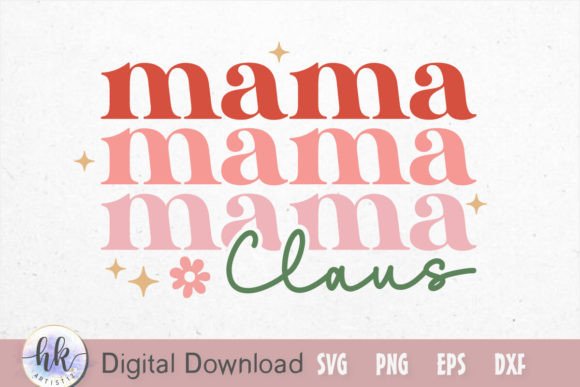
Opening the Mama Claus Retro SVG bundle feels like flipping through a vintage holiday catalog—warm, slightly cheeky, and full of personality. The design features a bold, rounded “Mama Claus” script with retro curves, a soft halo of holly or starbursts, and subtle graphic flourishes that nod to 1950s diner signage and mid-century holiday cards. It’s not overly detailed, but it’s intentional: clean lines, balanced negative space, and strong silhouette presence. As an embroidery designer who’s stitched hundreds of holiday motifs—from delicate snowflakes to dense reindeer scenes—I immediately saw how this would translate to thread: friendly without being cutesy, festive without leaning into cliché, and scalable without losing charm.
A Real Project Test: Embroidering a Linen Kitchen Towel
Last week, I used Mama Claus Retro SVG on a heavyweight natural linen tea towel for a local boutique’s holiday pop-up. Why this design? Because it’s got presence at 4.5 inches wide—big enough to read clearly when hung, small enough to avoid overwhelming the fabric’s texture. I digitized it as a machine embroidery design using satin stitch for the lettering and a light fill stitch for the halo elements. The result? Crisp edges, no puckering, and a handmade product that looked professionally finished—not DIY-ish. Customers paused, smiled, and asked, “Is that *her*? Mama Claus?” That recognition factor matters. It’s not just decoration; it’s a conversation starter, a warm wink in thread form.
Where It Shines (and Where It Needs Care)
Mama Claus Retro SVG works beautifully across several real-world embroidery projects—but context is key:
- Custom apparel: On medium-weight cotton sweatshirts and unisex tees, the design reads cleanly at 5–6 inches. Its open letterforms avoid dense stitch buildup, so it breathes well on knit fabrics—just use light cutaway stabilizer underneath.
- Tote bags & aprons: Perfect for front-panel placement. The 6×6 inch PNG file gives ample room for precise hoop alignment, and the transparent background makes mockup prep effortless for Etsy sellers building printable mockups.
- Baby embroidery & nursery decor: Softened with pastel thread colors (think mint, blush, cream), it reads gently—ideal for onesies or pillow covers. Avoid tiny versions under 3 inches though; the “Claus” loop detail starts to blur in satin stitch at smaller scales.
- Embroidered patches: With minor cleanup (tightening corners, simplifying inner curves), it converts well to applique design territory. Just confirm your embroidery software handles the EPS vector cleanly before exporting to PES or DST.
Fabrics & Fit: Know Before You Hoop
This isn’t a one-size-fits-all embroidery file—and that’s a good thing. Mama Claus Retro SVG demands thoughtful pairing:
- Textured fabrics (burlap, heavy twill): Works well—the bold shape holds up. Just increase stabilizer weight slightly to prevent thread snagging in loose weaves.
- Stretchy or thin fabric (ribbed knits, lightweight rayon): Proceed with caution. The lettering’s smooth curves can distort if hooping tension is uneven. Always test on scrap first, and consider adding a tear-away + wash-away combo stabilizer.
- Dark fabric: The design’s contrast relies on thread color choice—not outline weight. Use matte or tonal threads (e.g., charcoal gray on black) for sophistication, or go high-contrast (white or gold) for instant impact.
- Caps & curved surfaces: Not ideal out-of-the-box. The horizontal layout doesn’t wrap naturally. If you’re adapting it for a cap front, simplify the bottom curve and reduce overall height to 3.75 inches max.
What This Design Says About Your Brand—Without Saying a Word
When customers see Mama Claus Retro SVG on your finished product, they’re subconsciously reading your values: approachable craftsmanship, seasonal warmth, and a little creative confidence. It elevates a plain tote bag into a personalized gift. It adds handmade credibility to a small shop product without screaming “handmade!” in shaky script. For Etsy sellers, that quiet professionalism builds trust faster than five-star reviews—it signals you understand both design *and* execution.
That said, don’t assume automatic success. A poorly stitched Mama Claus Retro SVG on a wrinkled poly-cotton blend will look cheap—not charming. The design’s strength lies in its simplicity, which means flaws show up fast: skipped stitches in the “a” counter, thread breaks in tight curves, or halo elements bleeding into adjacent fabric. That’s why testing isn’t optional—it’s part of the design process.
Practical Designer Notes Before You Stitch
- Test Mama Claus Retro SVG on scrap fabric *matching your final project*—same weave, same stretch, same dye lot if possible.
- Check thread color contrast early: run a black-and-white mockup to verify legibility on light/dark backgrounds.
- Review stitch density in your embroidery software—especially where letters intersect. Overly dense areas trap moisture and wear faster.
- Confirm hoop size compatibility. At 6×6 inches, it fits standard hoops—but verify clearance on your machine’s arm and throat space.
- Inspect small details: the dot over the “i”, the curve of the “C”—these define character. If they vanish in stitch simulation, simplify manually.
- Use proper stabilizer: medium cutaway for knits, tear-away for stable wovens, and always float a lightweight topping for textured surfaces.
- Verify licensing: the product description says “perfect for your crafting projects”—but if you plan to sell finished embroidered items commercially (e.g., wholesale to boutiques), double-check usage rights for the Graphics file type.
Final Thought: A Design That Earns Its Place
Mama Claus Retro SVG isn’t flashy. It won’t dominate a craft fair booth with glitter or motion—but it earns repeat orders, photo tags, and heartfelt thank-yous because it feels human, intentional, and quietly joyful. It belongs in the Crafts toolkit of designers who value clarity over clutter, warmth over whimsy, and real-world performance over pixel-perfect previews. Whether you’re stitching holiday gifts for family or scaling production for your small shop, this design doesn’t ask for attention—it invites connection. And in embroidery, that’s the rarest stitch of all.