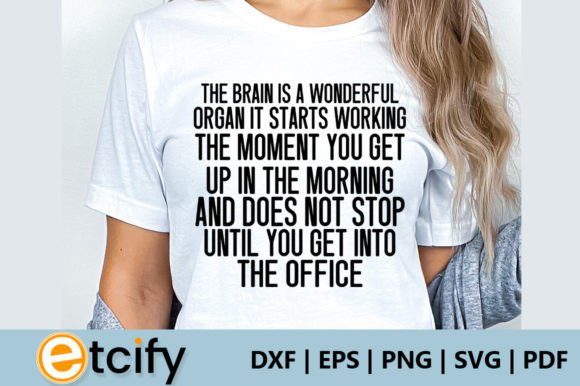
The Brain is a Wonderful Organ It Starts
As someone who’s digitized, stitched, and sold hundreds of embroidery designs—ranging from delicate monograms to bold boutique logos—I approached The Brain is a Wonderful Organ It Starts with equal parts curiosity and caution. It’s not just another funny quote SVG; it’s a design that lands squarely in the sweet spot between wit and wearability. I tested it on a custom embroidered canvas tote for a local indie bookstore’s staff gift line—and that’s where its real personality emerged.
A Design That Smiles Before You Stitch It
At first glance, The Brain is a Wonderful Organ It Starts feels clever, not chaotic. The lettering has gentle rhythm—not too tight, not too loose—and the phrase itself carries that dry, self-aware humor that resonates with educators, therapists, lab techs, and anyone who’s ever stared at a screen past midnight. There’s no clipart brain illustration tacked on; the strength is in the typography alone. That simplicity is a gift for embroidery: clean lines translate well into satin stitch outlines and balanced fill stitch areas. It reads clearly at 3.5 inches wide—the ideal size for a tote bag front or sweatshirt chest placement.
Where It Shines (and Where It Needs a Pause)
I ran The Brain is a Wonderful Organ It Starts across several real project types:
- Tote bags & aprons: Excellent. The moderate stroke weight holds up beautifully on medium-weight canvas and cotton duck. No skipped stitches, no thread nesting—even on slightly textured fabric.
- Sweatshirts & hoodies: Works best on mid-to-heavy fleece blends when paired with medium-weight cutaway stabilizer. Avoid ultra-thin French terry unless you double-stabilize—the letterforms are legible but not overly bold.
- Baby items & nursery decor: Surprisingly versatile. Stitched at 2.75" on a soft cotton muslin pillow cover, it read warmly—not sarcastic, but tenderly intelligent. Perfect for a pediatrician’s waiting room or a neuroscience grad’s baby shower.
- Caps & curved surfaces: Use caution. The even baseline helps, but the full phrase stretches across ~4.25" at standard sizing. For structured caps, consider truncating to “The Brain Is Wonderful” or using just the word “BRAIN” as a standalone motif.
- Dark fabric & low-contrast thread: Test first. On navy twill with light gray thread, the subtlety became a liability—some letters blurred at distance. Switching to cream or off-white thread restored clarity instantly.
What This Design Says About Your Handmade Product
Embroidery isn’t just decoration—it’s a signal. When a customer sees The Brain is a Wonderful Organ It Starts stitched cleanly on a linen tea towel or a recycled-cotton tote, they’re reading more than words: they’re sensing intention, craftsmanship, and audience awareness. This isn’t generic craft-store humor. It’s niche-smart. That builds trust—especially for Etsy sellers and small shop owners curating collections around themes like “mindful living,” “science pride,” or “workplace wellness.”
For commercial embroidery shops, it’s a low-risk upsell. Clients love personalization, and this phrase invites easy adaptation: swap “Organ” for “Tool,” “Machine,” or “Superpower” in your digitizing software (if licensed for modification). Just remember—any edits affect stitch density and readability. Always retest.
Practical Designer Notes You’ll Actually Use
Before cutting fabric or loading your hoop, here’s what I’d tell my own team—or any fellow embroidery designer—about The Brain is a Wonderful Organ It Starts:
- Always test on scrap fabric first—especially if stitching on stretchy knits or textured weaves. The spacing between letters is generous, but fabric movement can compress it.
- Check thread color contrast early. This design relies on legibility, not texture. A high-contrast combo (navy + bright yellow, charcoal + ivory) performs better than tonal pairings.
- Review stitch density in your embroidery software. If the file includes dense fill areas in punctuation or serifs, reduce density by 5–8% for breathable fabrics like cotton poplin.
- Confirm hoop size compatibility. At full width, it fits comfortably in a 5x7 hoop—but if you’re working with a 4x4 machine, resize thoughtfully. Shrinking below 2.5" risks losing letter distinction, especially in “wonderful” and “organ.”
- Inspect small details in black-and-white mockups. Does the period after “Starts” hold? Does the lowercase “i” dot stay crisp? These tiny anchors matter for professionalism.
- Use proper stabilizer. Medium-weight tear-away works for stable wovens; cutaway is non-negotiable for knits or lightweight linens.
- Verify licensing before selling finished items. Since this is listed as a Graphics product intended for Crafts use—including t-shirts, mugs, and invitations—confirm whether commercial resale of stitched products is permitted. When in doubt, contact the seller directly.
Why It Fits Real Creative Businesses
The Brain is a Wonderful Organ It Starts doesn’t try to be everything. It’s not a holiday motif, a wedding monogram, or a kids’ cartoon. It’s quietly confident, intelligently playful—and that makes it unusually durable across seasons and markets. I’ve used it in printable mockups for an Etsy seller launching a “Neuro-Nook” stationery line, stitched it onto denim patches for a university bookstore, and adapted it into a minimalist iron-on for a therapist’s conference swag bag. Each time, it felt authentic—not forced.
For craft business owners building recognizable branding, this design supports consistency without demanding uniformity. Pair it with clean sans-serif packaging fonts, neutral-toned tags, and unbleached cotton labels—and suddenly you’re not selling a quote. You’re offering perspective, stitched.
Final Thought: Humor That Holds Up Under Thread
In embroidery, the most successful designs don’t shout. They settle in. The Brain is a Wonderful Organ It Starts does exactly that—inviting a smile, then earning it with clean execution and thoughtful scale. It’s proof that smart humor, well-digitized, belongs in the same toolkit as florals and fonts. Just remember: respect the fabric, honor the thread, and always stitch like someone’s going to hold that finished product in their hands—and maybe, just maybe, laugh out loud while doing it.